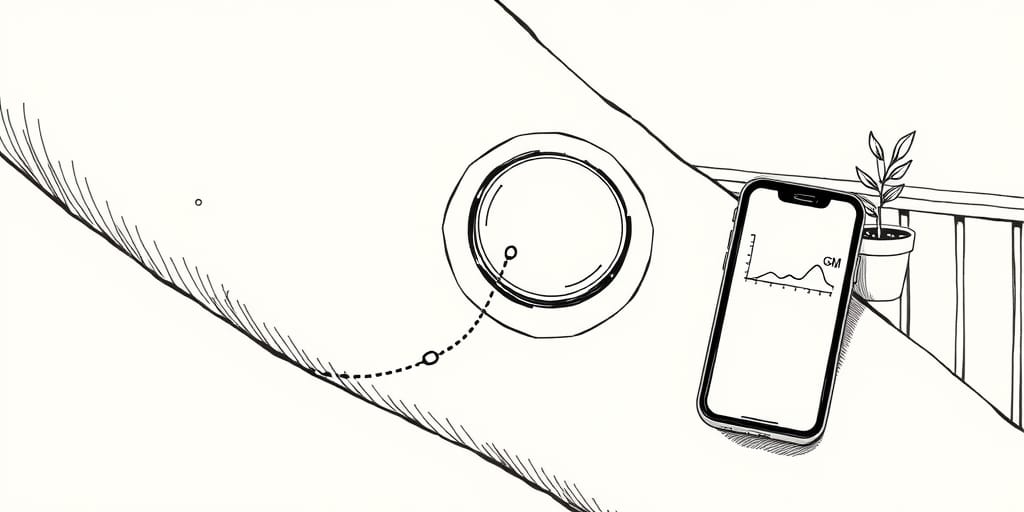
The continuous glucose monitor has become one of the defining objects of contemporary biohacking. Athletes, executives and influencers wear it on their arm without ever having received a diabetes diagnosis. The scientific literature tells a different story, one that is more precise and more narrow.
🌀 The sensor as performance object
In biohacking and personal optimization circles, the CGM has occupied a central place for several years. The narrative in circulation is appealing in its simplicity: seeing your blood glucose in real time lets you understand how your body responds to each meal, adjust your diet and improve your cognitive or athletic performance. Longevity podcasts, online guides and coaching platforms present it as a universal tool for biological self-knowledge.
This narrative rests on a solid factual foundation: the CGM has transformed diabetes management. But between "useful for a type 1 diabetic" and "relevant for optimizing a healthy athlete" lies a leap that the literature has not yet validated. That gap is precisely what this edition examines.

🔬 What the trials actually measured
The strongest evidence concerns a specific population: adults with type 2 diabetes who are not receiving insulin. A meta-analysis of 8 randomized controlled trials involving 541 participants measured the effect of CGM on two key indicators. The result: a mean HbA1c reduction of 0.37% and an increase in time in the target glycemic range of 8.84%. The statistical signal is robust (p less than 0.0001), but the clinical magnitude of the HbA1c reduction is judged modest by several analysts, particularly when set against the cost of the device.
In type 1 diabetes, the benefit is better documented and broader. Converging reviews, including an independent synthesis by Liebl and collaborators covering eight major studies (among them the JDRF CGM trials), conclude that glycemic control improves, with findings described as "robust but cautious." CGM also reduces time spent in hypoglycemia, a clinically important benefit for this population.
A cohort study published in the Journal of Managed Care and Specialty Pharmacy in 2024 additionally documents a reduction in healthcare resource use among diabetic patients equipped with a CGM, reinforcing the case for its integration into clinical follow-up. These data are observational and do not allow causality to be isolated, but they add to a convergent body of evidence in this population.
⚠️ What the biohacking narrative leaves out
The literature on CGM in adults without diabetes is considerably thinner. A systematic review published in the International Journal of Behavioral Nutrition and Physical Activity concludes that dietary behavior and physical activity improvements in this population are "modest," while highlighting substantial heterogeneity across studies and levels of evidence still insufficient for generalization. Glycemic response to food varies considerably from one individual to another: extrapolating one user's patterns to another, as several online biohacking guides do, is not scientifically founded.
Two blind spots deserve to be named. The first concerns behavioral risks: unsupervised CGM use in people without a pathology is associated in certain clinical observations with glycemic anxiety and unjustified dietary restriction, a phenomenon that has not yet been formally studied at scale but that several endocrinologists document in practice. The second concerns self-interpretation of data: without medical guidance, the variations displayed by the sensor can lead to dietary or behavioral adjustments that have no clinical basis.

A tool validated in one context is not a tool validated in all contexts.
📌 What the literature supports
The main signal is clear for one population: people with diabetes, both type 1 and type 2, achieve better glycemic control with a CGM, documented by randomized trials and convergent cohort data. The magnitude of the effect is modest in absolute terms in non-insulin-treated type 2 diabetics, but statistically and clinically consistent.
For non-diabetics, the available literature does not support the assertion of an established clinical benefit. Observational data suggest that real-time glycemic feedback can modify certain dietary behaviors, but the studies are heterogeneous, follow-up periods are short and the populations are poorly comparable. The convergence stops where the pathology is absent.

What this absence of data reveals
The structural blind spot in this literature is not the absence of a potential effect of CGM in non-diabetics. It is the absence of studies that seriously measure the risks specific to this use: glycemic anxiety, induced restrictive behaviors, the cognitive load of permanent monitoring. Research validated the tool for one indication, then looked elsewhere while the market expanded to an entire population without pathology.
Reading this subject differently means recognizing that the question is not "does CGM work?" but "for whom, with what support, and at what behavioral cost?" This question is not settled by the mean figure of 0.37% HbA1c: it is settled by the gap between a technology validated for a specific indication and a narrative that extends it to a population for whom the benefit-risk balance has not yet been seriously weighed.
- 1In non-insulin-treated type 2 diabetics, a meta-analysis of 8 randomized controlled trials documents a mean HbA1c reduction of 0.37%, judged statistically robust but clinically modest.
- 2In people without diabetes, evidence of a clinical benefit from continuous glucose monitoring remains poorly documented in controlled trials: the available literature does not settle the question.
- 3Unsupervised CGM use is associated with documented behavioral risks, including glycemic anxiety and unjustified dietary restriction.
Sources for this analysis, ranked by level of evidence and by function in the analysis. CGM meta-analysis in non-insulin-treated type 2 diabetes, NLM/NCBI (REFERENCE, National Library of Medicine). Function: documents the 0.37% reduction in HbA1c and the 8.84% increase in TIR across 8 RCTs involving 541 participants, the numerical backbone of this newsletter. Systematic review of CGM and health behaviors, International Journal of Behavioral Nutrition and Physical Activity (REFERENCE, peer-reviewed journal). Function: documents modest behavioral improvements and study heterogeneity in adults who are not exclusively diabetic, central to the blind-spot analysis. CGM and healthcare resource utilization, Journal of Managed Care and Specialty Pharmacy 2024 (REFERENCE, peer-reviewed journal). Function: documents reduced healthcare resource use among diabetic patients equipped with a CGM, convergent observational data. Review of CGM clinical implementation, Endocrinology and Metabolism (CONSENSUS, Korean Endocrine Society). Function: provides the clinical framework for CGM recommendations and the documented limitations in real-world practice. Independent review by Liebl et al. of major CGM trials, PMC/NLM (CONSENSUS, clinical literature synthesis). Function: documents "robust but cautious" conclusions on CGM efficacy in type 1 diabetes. CGM biohacking guide, UseVedic (PERIPHERY, biohacking popularization). Function: illustrates the narrative of dietary self-optimization via CGM in the absence of pathology, representative of the dominant non-medical discourse. Why non-diabetics are adopting CGMs, News-Medical.net (PERIPHERY, mainstream health popularization). Function: documents the stated motivations of non-diabetic users, used to frame the dominant narrative in block 1.